

Four fields for clearer thinking
- Claim: write a testable sentence without expanding what was said.
- Source: look for the origin, not just the person who forwarded it.
- Evidence: identify the relevant passage, table or record.
- Limit: explain what the evidence does not establish.
- Claim
What exactly could be checked?
- Source
Who published it, and when?
- Evidence
Which passage supports the claim?
- Limit
What remains unconfirmed?
How we publish
We distinguish historical records, present-day checks and proposals. Capture dates do not replace publication dates. When a source changes or an error is found, a correction should explain what changed.
Some claims remain unconfirmed. That is a useful outcome when evidence is missing; it should not become an accusation or a statement of certainty.
Bring the method into the conversation
Open the worksheet to use these fields. The guides to messages and sources show two different situations.
Complete a record without copying a private conversation
Use paper or the local worksheet with a claim reduced to what can be checked. Names, phone numbers, profile photographs and the entire conversation are unnecessary for defining a question. The example below is synthetic: the centre and notice do not exist.
- Separate the claim from the person who forwarded it. Example: “The fictional Aurora centre opens registration on 12 November.” The sender’s identity does not establish the date.
- Keep only needed fields: the alleged issuer’s public name, claimed date, expected document and public URL if available. Do not copy a private link containing a token, access code or someone else’s data.
- Find the original publication and the passage supporting the date. A screenshot without provenance is not the document; ten forwards of the same screenshot are not ten independent confirmations.
- Record what is missing and choose a proportionate conclusion. Without the original notice, leave the date unconfirmed. Missing evidence is not an accusation of lying.
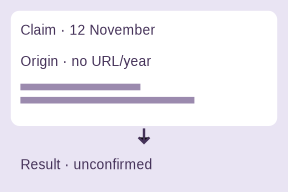
Completed synthetic record: claim: Aurora centre registration on 12 November; available origin: an image without URL or year; evidence: only the sentence in the image; missing: issuer’s notice, year and conditions; conclusion: date unconfirmed; next step: locate the issuer’s public page before sharing. Private conversation data copied: none. No real institution is assessed in this example.
Before saving: remove the sender’s name, number, address, third-party image and private parameters. If those details are essential to a professional investigation, this public worksheet is not the place to transmit them. Keep only the necessary public reference without exposing the source to risk.
Template: exact claim ___; public issuer ___; date/year ___; public URL and passage ___; contrary evidence ___; limitation ___; conclusion ___; next step ___; revision and change ___. An empty field stays “not found”, not “confirmed”. IFCN’s source principles help make reasoning checkable; linking them does not claim Otwoo certification or membership. The record can remain entirely on paper and does not require sending a message to a bot.
By Otwoo · Updated
Illustrated material for this edition. Read the policy.