

Compare the claim with the document
Note who published it, when and for what purpose. Separate quotations, interpretation and data. Check whether a table reports totals, percentages or only a sample. A headline or isolated extract can omit a condition that changes the meaning.
Fictional example: a total is not a forecast
A report records 120 registrations received in April. That does not establish that 120 people attended or guarantee the same number in May. Record the correct unit in the worksheet: registrations, during April. Attendance and future projections remain unsupported by that document.
Leave a trail someone else can follow
Record the address, title, section or page and the date you consulted it. Write one sentence explaining what the source confirms and another explaining what it does not. If a page is unavailable, identify an archived capture as historical.
Use the worksheet; read NILC-FakeNews for the project’s background.
By Otwoo · Updated
Sources and references
Follow a screenshot to the exact document version
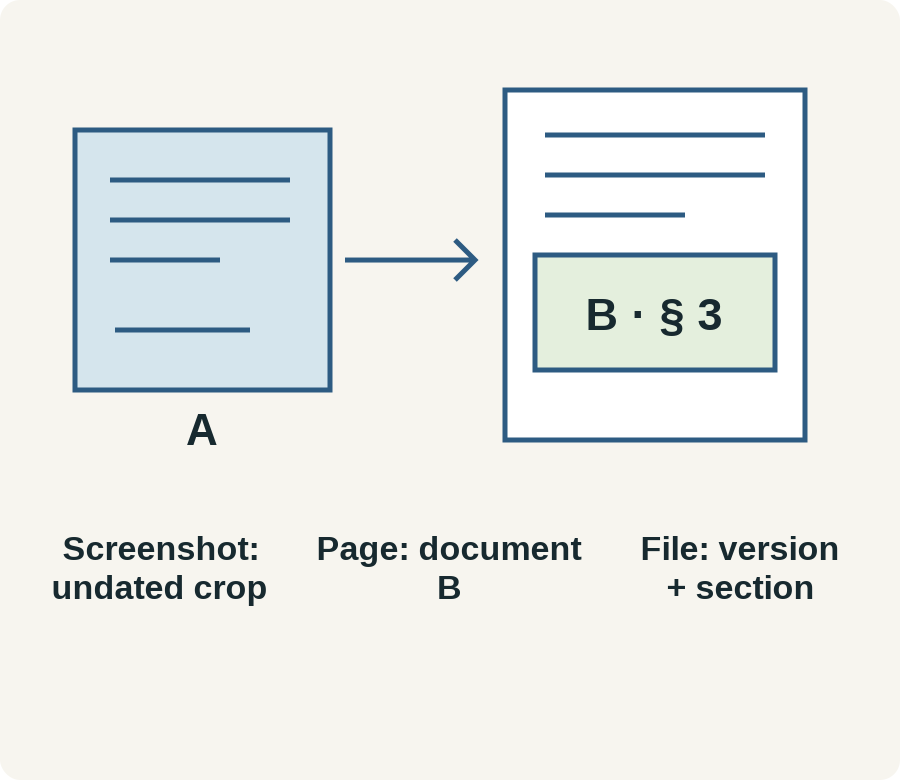
A screenshot can preserve words while losing a date, caption or revision. Follow the chain to an identifiable version. This is a synthetic case, not an allegation against a real publication.
- Transcribe the cropped claim without completing missing words. Look for a visible author, title or document name; sharing counts are not identification.
- On the source page, locate the cited document and check title, responsible institution, version and section. A link to an institution alone does not confirm the sentence.
- Compare the file's passage with the screenshot's claim. Record any condition that changes its meaning and whether a later version exists. If the file cannot be opened, leave the comparison incomplete.
Filled record: screenshot: “available to everyone”; document B, section 3: “available to registered participants”. The crop omitted the condition. Exercise conclusion: this passage does not support the universal claim. It does not establish who made the crop or their intention.
Worksheet: claim __; source page __; file/version __; section __; wording and condition __; comparison completed or pending __. This reading worksheet sends no screenshots, personal text or files to the server.
Source: www.unesco.org.
Half a corpus is not half of all news
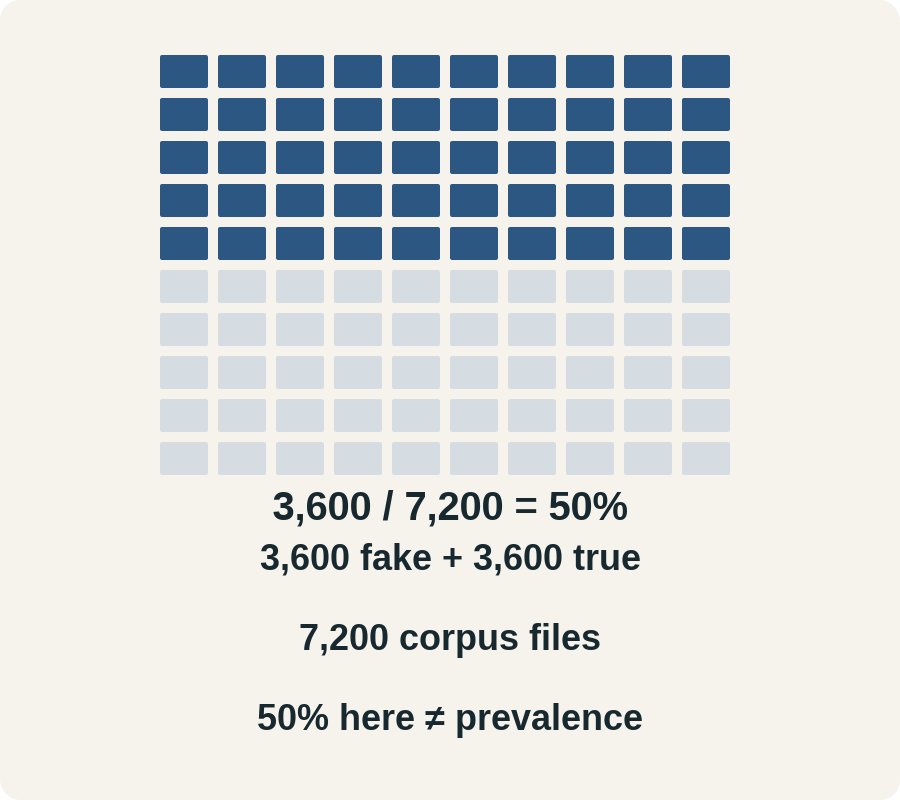
A percentage needs a denominator and a selection rule. In the primary Fake.Br repository, a count checked on 31 October 2026 at revision 780f5516c4ae finds 3,600 files in full_texts/fake and 3,600 in full_texts/true. The unit is a text file in those directories, not every news story published in Brazil.
- Identify the version, directories and unit. Metadata and preprocessed versions are not additional stories to add to the same total.
- Calculate the base: 3,600 + 3,600 = 7,200. The fake-directory share is 3,600/7,200 × 100 = 50%.
- Limit the conclusion to that selection: half the counted files in this corpus are in its fake category. Do not turn dataset composition into an estimate for the entire internet.
- Separate dataset composition from system performance. This calculation tests neither Otwoo nor accuracy, sensitivity or medical reliability.
Completed record: source=authors’ repository; revision=780f5516c4ae; unit=TXT file in two directories; numerator=3,600; denominator=7,200; conclusion=50% within this corpus; generalization to Brazilian news=unsupported. The project reference is Monteiro and colleagues, PROPOR 2018; today’s file-count check does not change the research date.
Each diagram cell represents 72 files; 50 of its 100 cells represent the fake category. They are not 100 individual stories or our system’s predictions. Record: claim __; unit __; selection __; version __; numerator __; denominator __; calculation __; limit __. No personal messages or medical data need to be submitted for this exercise.
Source: github.com.