Home / Digital robots, bots and chatbots: a historical discussion | Otwoo
OTWOO · LANGUAGE, TECHNOLOGY, CONTEXT
Digital robots, bots and chatbots: a historical discussion
The article distinguished software automation from physical robots and discussed the limits of the word chatbot. Its argument is preserved as a historical viewpoint.
The starting distinction
The document used digital robot and virtual robot for software performing automated actions. It separated this subject from physical machines while imagining integrations that could act beyond the screen. This was the author’s framing for the Otwoo proposition.
Conversation and action
The central argument was that a messaging interface could receive more than text and trigger integrations rather than merely return sentences. The author named WhatsApp, Messenger and Telegram as possible channels. This discussion does not demonstrate that all integrations remain available.
A position rather than an official dictionary
The text argued for a preferred terminology. Here that preference is identified as the article’s position, rather than a universal definition or a claim that chatbot is an invalid term. Read it alongside the speech-and-language article and the Online-to-Offline proposition.
Found in the archive: Common Crawl WARC, captured on 2021-01-21 (UTC). Original document: https://otwoo.com.br/?p=224. A capture date is not a publication date. This page is a new reconstruction; it does not reproduce the original wording.
A convincing chatbot response is a claim to verify. A cited reference may not exist, may not support the claim or may repeat another publication. NIST published a risk-management profile for generative systems in 2024. It supplies no accuracy rate for the historical Otwoo applications.
Separate the sentence into checkable elements: institution, announced change, effective date and place. Do not send an entire private conversation to another service.
Open the supplied reference. Check its title, responsible organisation, date and the passage that actually supports the claim. A missing page is not a source.
Find the named institution’s original notice and check its period. An authentic older notice may answer a different question.
Seek independent confirmation where needed. Two articles copying one notice still rely on a single origin.
Use a proportionate conclusion: confirmed for a stated date, contradicted by a specified source or not confirmed. Missing evidence is not permission to invent a rebuttal.
An entirely fictional example
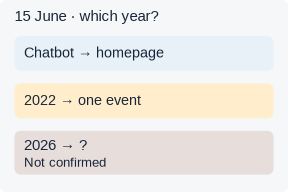
The chatbot says:“Delta Library opens on Sundays from 15 June.” Its link reaches a homepage without that notice. A 2022 article describes one exceptional Sunday opening. The response gives no year. Result:“Recurring opening from 15 June was not confirmed by the sources checked. The 2022 report concerns a different event.” Do not write“the library is closed”: that has not been established either.
Reusable record: exact claim __; year/place __; cited link __; original notice __; date/scope __; independent origin or copy __; confirmed part __; unresolved part __. Keep only necessary excerpts without usernames or private messages. This exercise does not contact an operational bot, send text to a server or measure model accuracy.